

Top Faux Wood Wall Panels Manufacturers in China

Choosing Faux Wood Wall Panels from China takes more than comparing photos and prices. A warm oak pattern may look convincing online, yet the sample can reveal a different grain, sheen, or edge finish. Small details matter.

Architect Alex de Rijke once called wood “the new concrete.” His observation captures wood’s visual appeal, but faux wood panels bring different practical questions. Buyers should compare core materials, surface durability, panel dimensions, installation methods, and available test documentation. Ask for a physical sample. Check it under natural and indoor light. Run a fingertip across the surface; texture can change the impression completely.

Details count.

This guide introduces leading Chinese manufacturers and the factors that help buyers assess them. It considers product range, customization, production consistency, communication, and export experience. A polished catalogue is useful, but it cannot prove that every production batch will match the sample. That deserves scrutiny. Request clear specifications and confirm how packaging protects corners during shipment. For projects in humid rooms, ask about the panel’s intended environment and care requirements rather than assuming every finish performs alike.

No supplier is perfect for every project. The right choice depends on design goals, budget, installation conditions, and the evidence a manufacturer can provide. This overview offers a starting point—not a substitute for checking samples, documentation, and project-specific needs.
Top Faux Wood Wall Panels Manufacturers in China

What Faux Wood Wall Panels Are and How They Differ from Natural Wood

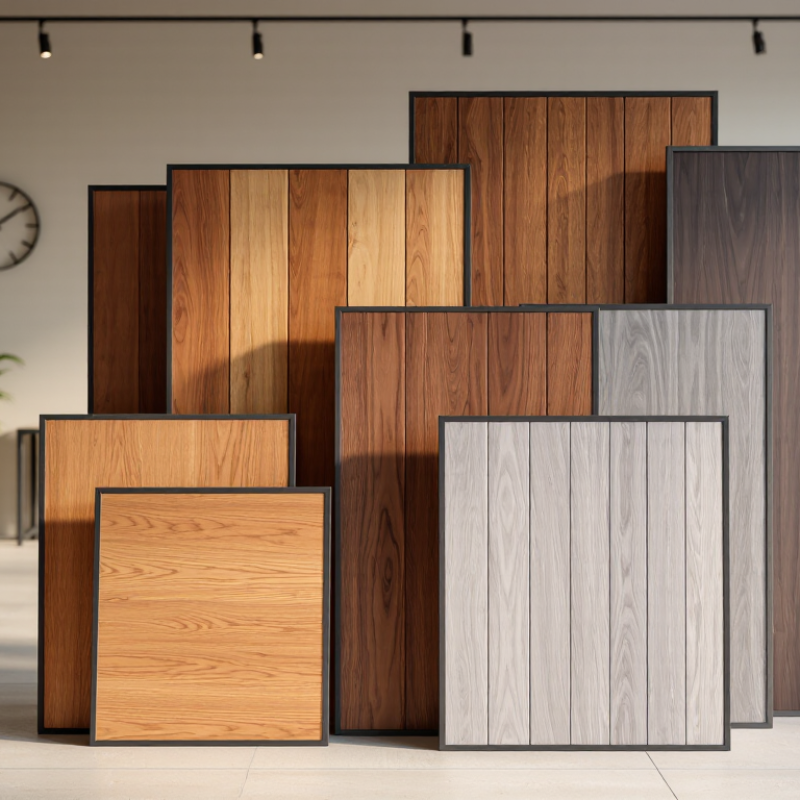
Faux wood wall panels are manufactured surfaces designed to echo the color, grain, and texture of timber. Depending on the product, their core may use PVC, wood-plastic composite, or engineered board, with a printed or embossed finish. They are not all built alike. Check the stated core material and installation requirements before choosing a panel.

Natural wood has grain that varies from board to board, and its surface can change with age, light, and humidity. Faux panels usually offer a more consistent pattern, which can make a large wall look orderly, though repeated grain may become noticeable up close. Some products handle moisture better than untreated wood, but that does not make every panel suitable for a wet room. Details matter. Look at the edges, surface sheen, and sample pieces under the room’s actual lighting. A convincing print can still feel less warm to the touch than solid timber. That trade-off is easy to overlook. For busy interiors, simpler cleaning and predictable sizing may be useful; for a renovation, fitting around uneven corners can still require careful measuring and cutting.

Materials, Surface Finishes, and Manufacturing Methods

For faux wood wall panels, Chinese manufacturers commonly start with MDF, plywood, or polymer-based substrates. MDF gives a smooth face for printed grain, while plywood can provide better screw-holding strength. The choice affects weight, machining, and moisture response. Details matter.

FAO’s 2023 forest-products review reported global wood-based panel production of about 399 million cubic metres in 2022, down roughly 3% from 2021. This scale makes substrate selection and consistent batch control important. Surface options include textured films, embossed laminates, and coated veneers. Embossing can add shallow grain lines, but overly uniform patterns may look artificial under side lighting.

Manufacturing typically combines substrate cutting, surface lamination or coating, edge finishing, and quality checks. Buyers can request cross-sections, finish samples, and test results for thickness, adhesion, and dimensional stability. A sample should be viewed in the intended room light. Not every time. Moisture-resistant claims also need clear test conditions; a decorative face alone does not make a panel suitable for damp spaces. Some specifications remain easy to overlook, including edge sealing and colour variation between production runs.

Common Applications in Residential and Commercial Spaces

Faux wood wall panels can bring warmth to residential rooms without the upkeep of natural timber. In living rooms, they work well behind a sofa or television, where vertical grain can make a plain wall feel more considered. In bedrooms, a paneled headboard wall adds texture without taking up floor space. A subtle finish matters. Very glossy surfaces may look artificial under bright lamps, while deeper grooves can collect dust.

Kitchens, hallways, offices, and shops also use these panels, but the setting should guide the choice. Near sinks or busy entryways, check the product’s moisture resistance and cleaning instructions; decorative panels are not automatically waterproof. In offices and reception areas, wood-look surfaces can soften hard materials such as glass and concrete. Still, repeating the same pattern across a large wall may feel too uniform. When comparing panels from manufacturers in China, review sample colors, panel dimensions, installation requirements, and relevant test documentation. A sample beside the actual flooring can reveal color clashes that a screen conceals.

Top Faux Wood Wall Panels Manufacturers in China – Common Applications in Residential and Commercial Spaces

Panel Type Typical Construction and Specifications Residential Applications Commercial Applications Selection Considerations
PVC Decorative Wall Panels Extruded PVC; commonly supplied in plank or narrow-strip profiles. Typical thickness is approximately 5–10 mm, with widths often around 200–300 mm. Bathrooms, laundry rooms, kitchens, utility areas, and feature walls where easy cleaning is useful. Retail back-of-house areas, budget accommodation, service corridors, and other interior spaces requiring low-maintenance finishes. Check the product’s intended wet-area use, joining details, fire-performance documentation, and installation requirements. Not every PVC panel is suitable for direct water exposure.
WPC (Wood-Plastic Composite) Panels Wood-fibre or wood-flour and polymer composite, often formed as solid or hollow profiles. Interior products commonly range from about 8–15 mm thick. Living-room feature walls, bedrooms, hallways, and interior accent areas designed to create a wood-look finish. Office reception areas, hotel interiors, retail displays, and restaurant feature walls. Confirm whether the product is specified for indoor or outdoor use. Check expansion allowances, fixing method, surface finish, and applicable fire requirements.
Melamine-Faced MDF Panels Medium-density fibreboard with a decorative wood-grain melamine surface; panel thickness commonly ranges from 6–18 mm, depending on use. Wardrobe or cabinet surrounds, study areas, bedroom feature walls, and dry interior wall linings. Office wall finishes, shopfitting, meeting rooms, and reception areas in dry indoor environments. Protect cut edges from moisture and use suitable fixings. Specify the required substrate grade and surface durability for the intended location.
Decorative-Laminated Plywood Panels Plywood core with a printed, laminated, or paper-resin wood-grain surface. Overall thickness is commonly around 6–18 mm. Feature walls, furniture-backed wall sections, and interior areas where a panel with a plywood core is preferred. Retail interiors, hospitality fit-outs, office partitions, and display installations. Ask for details about the plywood core, veneer or laminate finish, edge treatment, emissions documentation, and fire classification where required.
Wood-Grain PVC/WPC Fluted Panels Grooved or ribbed profiles with a wood-look surface; commonly installed as individual boards or modular sections. Profile depth and width vary by design. TV feature walls, entryways, stairwell accents, and decorative sections in living or dining areas. Hotel lobbies, café interiors, reception desks, retail feature walls, and selected office spaces. Review the profile’s cleaning requirements, corner and edge trims, acoustic expectations, and substrate preparation before installation.
Wood-Grain HPL Wall Panels High-pressure laminate bonded to a suitable panel substrate; finished thickness depends on the core and laminate construction. Kitchen or hallway feature surfaces and other interiors where a hard-wearing decorative finish is desired. Healthcare, education, hospitality, retail, and office interiors, subject to the specified panel system and project requirements. Confirm that the complete panel assembly—not only the decorative laminate—meets project requirements for impact, cleaning, moisture, and fire performance.

Note: Specifications and application suitability vary by product and supplier. Dimensions above are indicative ranges for common interior panel formats, not guaranteed standards. Verify technical data, installation instructions, emissions information, and local building-code requirements before procurement.

How to Evaluate Faux Wood Panel Manufacturers in China

Evaluating faux wood wall panel manufacturers in China starts with a physical sample, not a polished catalogue. Check whether the grain looks consistent across several panels. Run your fingers over the surface; printed texture can feel flat even when photographs look convincing. Inspect the edges, corners, and backing too. Small details matter. Ask for samples from regular production, not only a specially prepared display piece.

Review how the manufacturer controls materials and quality. Ask what the panel core, surface coating, and backing are made from, and request written product specifications. A reliable supplier should explain thickness tolerances, moisture limits, and cleaning recommendations clearly. Ask how defects are recorded and what checks happen before packing. If possible, compare a sample with a batch inspection report. Numbers help, but unclear testing methods deserve follow-up.

Production capacity matters only if it fits your order and schedule. Ask for a realistic lead time, packing photos, and details about how panels are protected against scratches during shipping. Check whether the supplier can provide installation guidance and replacement parts if a shipment arrives damaged. I would also test a small order before committing to a large one. It takes extra time, and the result may still need careful review. A confident sales reply is not the same as verified performance.

Leading Chinese Manufacturers and Their Product Specialties

Chinese faux wood wall-panel manufacturers tend to specialize by process. WPC producers use wood fiber and polymer extrusion to make rigid slatted boards for feature walls and covered outdoor areas. PVC-panel factories focus on lightweight, moisture-resistant boards, often with printed or laminated wood-grain finishes. Other suppliers work with engineered wood, offering smoother surfaces for painted or decorative interiors. These products are not interchangeable. Check the panel core, edge finish, and stated installation conditions, not just the grain pattern.

Manufacturers also differ in customization. Some can adjust board width, embossing depth, and surface sheen; others concentrate on standard profiles and higher-volume orders. Ask for a sample that shows the actual edge and finish. A caveat remains: catalog claims alone rarely show how a panel performs after years of heat, humidity, or cleaning. The UN Environment Programme’s 2023 Global Status Report for Buildings and Construction estimates that buildings accounted for 37% of global energy- and process-related CO₂ emissions in 2022. That figure does not rank panel materials, but it makes product life and replacement frequency relevant questions. Details matter. Request test methods, warranty terms, and installation guidance alongside price.