


How to Choose a Carbon Facial Machine for Your Business
Choosing a Carbon Facial Machine for your business requires more than comparing prices and polished product photos. The right equipment should support safe treatments, consistent results, and a realistic return on investment. A machine may look impressive in a showroom, yet perform poorly when staff use it daily.
Begin by examining the technology, treatment settings, and manufacturer documentation. Ask how the device manages laser energy, vacuum strength, carbon application, and cooling. Clear controls matter when a practitioner is treating different skin types under busy salon conditions. Request training materials and confirm whether technical support is available in your region. Reliable suppliers should explain maintenance schedules, replacement parts, warranty terms, and applicable professional requirements.
Consider the treatment environment too. Measure your available space, including room for cables, cleaning supplies, and client movement. A compact device may suit a small clinic, while a larger system could offer useful features for a medical aesthetic practice. Review customer feedback carefully, especially comments about downtime, calibration, and service response. One glowing review proves little.
Think about the people using it. Staff should understand contraindications, patch testing, eye protection, sanitation, and aftercare. Local regulations and professional licensing rules may also affect your purchase. Verify them before signing a contract. A supplier’s confidence is helpful, but documented evidence is better.
Finally, calculate the complete cost. Include consumables, training, maintenance, marketing, and expected appointment volume. Avoid assuming every client will return monthly. That assumption may be wrong. A suitable Carbon Facial Machine should fit your expertise, budget, client profile, and long-term business plan. No checklist is perfect, but careful questions can prevent an expensive mistake.
Define Business Goals and Set 1064 nm Nd:YAG Treatment Requirements
Define your business goal before comparing a carbon facial machine. The ISAPS 2023 Global Survey recorded more than 19 million nonsurgical procedures worldwide. That figure signals demand, not guaranteed revenue. Decide whether your clinic needs quick, low-downtime facials, pigmentation support, or higher-value combination treatments. A busy salon may prioritize short sessions and easy maintenance. A dermatology practice may require finer control and stronger documentation.
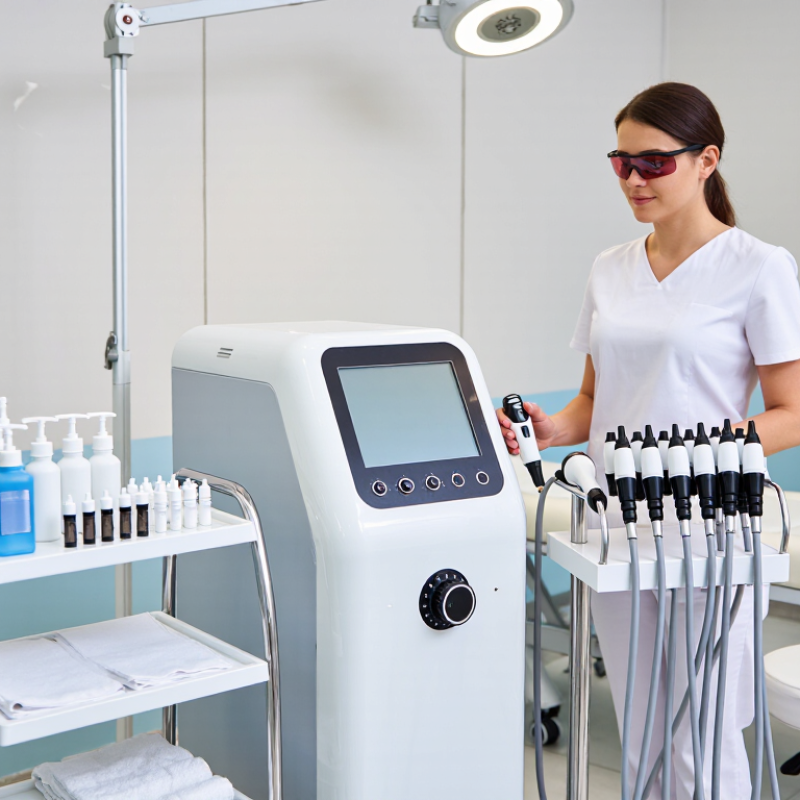
For 1064 nm Nd:YAG treatments, assess measurable specifications rather than attractive claims. Ask for adjustable fluence, pulse duration, spot size, repetition rate, and stable energy output. These controls affect treatment comfort, coverage, and operator precision. Confirm the machine’s cooling method and emergency shutoff. A 2023 review in Lasers in Medical Science describes 1064 nm Nd:YAG light as capable of deeper dermal penetration than shorter wavelengths. That benefit also demands careful skin assessment, eye protection, and trained operation. Darker skin types need conservative settings and consistent monitoring.
Request independent test reports, electrical safety certification, service records, and operator training materials. The ASDS 2023 Consumer Survey found that 70% of respondents were considering a cosmetic procedure, but consumer interest does not replace clinical evidence. Track treatment time, repeat visits, consumable costs, and adverse reactions during a supervised pilot period. Numbers can disappoint. My own practical concern is often overlooked: a powerful system may remain idle if staff find its interface confusing. Choose usable control over impressive maximum output.
How to Choose a Carbon Facial Machine for Your Business
Define your business goals first, then check whether the machine supports the appropriate 1064 nm Nd:YAG fluence range for each intended treatment.
The ranges shown are representative clinical planning ranges for 1064 nm Nd:YAG applications. Actual settings depend on skin type, spot size, pulse duration, cooling, treatment indication, and the device manufacturer's instructions.
Compare Fluence, Pulse Duration, Spot Size, and 1–10 Hz Repetition Rates
Choosing a carbon facial machine requires more than comparing power ratings. Fluence, measured in joules per square centimeter, controls the energy delivered to the skin. Higher fluence may improve carbon-film vaporization, but it can also increase discomfort and redness. A practical setting should match skin condition, carbon coverage, and treatment area.
Pulse duration affects how quickly that energy reaches the tissue. Short pulses can feel sharper and may suit controlled, precise work. Longer pulses spread heat more gradually, which can support comfort but slow the session. Spot size changes coverage and energy density. A larger spot may treat cheeks efficiently, while a smaller spot offers better control near the nose. Measure the actual spot size, not only the advertised handpiece diameter.
Repetition rates from 1–10 Hz influence treatment speed and heat buildup. Lower rates allow more time between pulses and easier skin observation. Higher rates can improve workflow, but rushed passes may create uneven heating. I prefer testing several settings on a small area before treating the full face. Keep records of fluence, pulse duration, spot size, repetition rate, skin response, and operator technique. Do not assume one preset fits every client. Even experienced operators can misjudge heat when carbon coverage is uneven. Cooling, eye protection, staff training, and documented maintenance remain essential purchasing criteria. A machine with impressive specifications is not automatically the safest choice.
Verify IEC 60601-1 Safety and FDA 21 CFR 1040.10 Compliance
When choosing a carbon facial machine, verify safety before comparing power, spot size, or price. If the device uses a laser, request evidence of compliance with FDA 21 CFR 1040.10. This regulation addresses laser performance, protective housing, warning labels, emission indicators, and safety controls. Ask for the laser class, wavelength, maximum output, and test records. Marketing language is not evidence.
IEC 60601-1 covers basic electrical safety and essential performance for medical electrical equipment. Look for a current test report from an accredited laboratory, not only a certificate with no test scope. IEC 60601-1-2 electromagnetic compatibility testing also matters. A machine can appear stable but fail near electrosurgical or wireless equipment. That detail is easy to overlook. I would check the power cord, emergency stop, footswitch, interlock, and protective eyewear during a live demonstration.
The World Health Organization’s Global Patient Safety Action Plan 2021–2030 reports that one in ten patients experiences harm in healthcare, with more than half considered preventable. This figure is not specific to carbon facials, but it shows why verification cannot be treated as paperwork. Keep copies of reports, labeling, maintenance records, and operator training logs. A certificate alone does not prove every delivered unit matches the tested model. That is a weak point worth questioning. Also confirm whether the product is a laser or another light-emitting device, because 21 CFR 1040.10 may not apply in the same way.
How to Choose a Carbon Facial Machine for Your Business - Verify IEC 60601-1 Safety and FDA 21 CFR 1040.10 Compliance
| Evaluation Dimension | Recommended Selection Benchmark | What to Verify Before Purchase | Business Relevance | Priority |
|---|---|---|---|---|
| Primary laser wavelength | A Q-switched or quality-switched Nd:YAG platform commonly uses 1064 nm for deeper targets and may provide 532 nm for selected superficial pigment applications. | Confirm the wavelength, pulse mode, optical output, and whether each wavelength is covered by the device documentation and regulatory submission. | Determines treatment versatility, eye-hazard controls, consumables, and staff training requirements. | Critical |
| Pulse duration and operating mode | For carbon facial applications, look for a documented short-pulse mode suitable for the intended indication. Do not select solely on a quoted “maximum power” value. | Request pulse-duration ranges, pulse-energy accuracy, repetition-rate limits, and test reports for each operating mode. | Consistent pulse delivery supports predictable treatment protocols and reduces the risk of excessive thermal exposure. | Critical |
| Fluence and spot-size control | Choose a system with adjustable fluence and practical spot-size options, such as a range that can accommodate both small facial areas and larger treatment zones. | Verify calibrated output at the selected spot sizes, beam-profile data, adjustment increments, and whether displayed settings match delivered energy. | Improves protocol flexibility and helps operators adapt treatment parameters while maintaining control. | Critical |
| IEC 60601-1 electrical safety | The medical electrical equipment should be evaluated against IEC 60601-1, including basic safety and essential performance requirements applicable to the equipment configuration. | Obtain a valid test report or certificate identifying the exact model, variants, applied parts where relevant, edition used, and recognized testing laboratory. | Reduces electrical, mechanical, and operational safety risks and supports facility procurement review. | Critical |
| FDA 21 CFR 1040.10 laser compliance | The finished laser product should meet applicable FDA performance requirements for laser products under 21 CFR 1040.10, including required safety features, labeling, certification, and reporting obligations. | Request the product report or applicable FDA filing evidence, product classification, certification label information, user manual, warning labels, and service documentation. Confirm that the evidence applies to the exact model. | Helps prevent import, installation, advertising, and operational compliance problems in the United States. | Critical |
| Laser safety classification and controls | Confirm the actual laser classification from the manufacturer’s technical documentation. High-power aesthetic laser systems may require controlled-area procedures and trained authorized users. | Check key control, remote interlock, emission indicator, emergency stop, protective housing, beam aperture controls, and compatible wavelength-specific eyewear. | Supports staff and client protection and may affect room design, insurance, and local workplace requirements. | Critical |
| Protective eyewear | Provide eyewear specifically rated for every emitted wavelength, including the relevant optical density and laser safety standard information. | Verify wavelength range, optical density, markings, fit, condition, cleaning method, replacement schedule, and availability of patient and operator eyewear. | Correct eyewear is a basic control against potentially serious retinal or ocular injury. | Critical |
| Cooling and temperature management | Prefer active cooling or a clearly defined contact-cooling method when required by the treatment protocol; cooling must not be treated as a substitute for correct laser parameters. | Review cooling capacity, temperature monitoring, alarm conditions, maintenance intervals, coolant requirements, and disposable-contact procedures. | Can improve client comfort and treatment workflow while helping manage unwanted heat accumulation. | High |
| Smoke and particulate control | If the procedure generates smoke, vapor, or airborne particles, use local exhaust or an appropriate laser plume management system according to the risk assessment. | Confirm compatible filtration, filter efficiency information, airflow, replacement intervals, noise level, and cleaning requirements. | Improves room air quality, operator comfort, infection-control planning, and client experience. | High |
| Electrical and facility requirements | Confirm the rated voltage, frequency, maximum input power, plug type, dedicated circuit needs, ventilation, and environmental operating limits before installation. | Compare the equipment nameplate, installation manual, local electrical code, circuit capacity, room temperature, humidity, and clearance requirements. | Prevents installation delays, nuisance shutdowns, overheating, and unexpected facility costs. | High |
| Documentation and traceability | A complete technical file should identify the exact model, serial-number range, specifications, intended use, contraindications, warnings, maintenance, and training requirements. | Check the user manual, service manual, risk documentation, calibration records, declaration of conformity where applicable, and revision-controlled labeling. | Makes staff onboarding, audits, incident investigation, and routine maintenance more reliable. | High |
| Operator training and clinical governance | Select equipment with structured training covering laser physics, skin assessment, parameter selection, eye protection, adverse-event response, and record keeping. | Verify training syllabus, competency assessment, refresher requirements, authorized-user controls, and alignment with local professional regulations. | Reduces operator error and supports consistent service quality and regulatory accountability. | High |
| Maintenance and calibration | Require a documented preventive-maintenance schedule and periodic verification of pulse energy, aiming, interlocks, cooling, and emergency-stop functions. | Confirm service intervals, calibration method, qualified service personnel, response time, spare-parts availability, and maintenance-cost estimates. | Protects uptime, performance consistency, and the useful operating life of the equipment. | High |
| Claims, intended use, and marketing | Use only treatment claims supported by the device’s cleared, authorized, or otherwise legally permitted intended use in the target market. | Compare brochures, website claims, labeling, user manual, and regulatory documents. Do not equate IEC 60601-1 testing with FDA marketing authorization. | Reduces advertising risk and helps ensure that services are promoted within the permitted scope. | Critical |
| Total cost of ownership | Evaluate purchase price together with installation, training, eyewear, plume filters, cooling consumables, service, calibration, downtime, and replacement parts. | Request a three-year cost forecast and document warranty coverage, exclusions, consumable prices, service rates, and expected maintenance frequency. | Provides a more realistic basis for pricing, break-even analysis, and return-on-investment planning. | High |
Assess Carbon-Lotion Compatibility, Cooling, Fitzpatrick I–VI Safety, and Training
Choosing a carbon facial machine starts with the carbon lotion, not the display panel. Ask for ingredient, viscosity, drying time, and recommended wavelength data before testing. A thick formula may absorb energy unevenly. This can cause patchy heating or uncomfortable hotspots. Test a small area first.
Cooling should be measurable, not merely advertised. Check whether the handpiece offers stable contact cooling, controlled airflow, or another documented method. Inspect the skin during treatment, especially around the nose and cheekbones. For Fitzpatrick I–VI clients, the machine should allow adjustable fluence, pulse duration, and spot size. Darker skin can face a higher risk of post-inflammatory hyperpigmentation. No setting makes every skin type risk-free.
Training must cover eye protection, contraindications, test spots, endpoint recognition, cleaning, and incident records. Ask whether practical assessment is included. A certificate alone may not prepare staff for unexpected redness or uneven carbon removal. In my experience, written protocols help, but they cannot replace supervised practice. I would rather delay a launch than let an inexperienced operator increase energy too quickly. Some equipment manuals remain vague. That is a warning worth discussing with the supplier.
Calculate ROI Using Treatment Time, Consumables, Warranty, and Service Costs
How to Choose a Carbon Facial Machine for Your Business
A carbon facial machine should earn its place through measurable operating value. Start by recording treatment time, setup time, and cleaning time. A 25-minute session may require 40 minutes in practice. That difference affects daily appointment capacity. Calculate monthly revenue using realistic bookings, not the manufacturer’s maximum schedule. For example, eight treatments daily at $70 creates different results than five fully booked appointments.
Track every consumable used per treatment, including carbon lotion, tips, wipes, and protective materials. Small costs become significant after hundreds of sessions. Subtract these expenses from each treatment’s selling price. Then include staff wages, payment fees, room usage, and routine maintenance. An affordable machine can still produce weak returns when consumables are expensive or frequently wasted.
Warranty length matters, but coverage details matter more. Confirm which parts are included, how claims are handled, and whether downtime is covered. Ask about technician response times and access to replacement components. One missed weekend can reduce revenue more than expected. My first ROI spreadsheet ignored service delays, which made the forecast look too optimistic.
A better calculation uses this formula:
Review the numbers after three months. Real booking patterns may challenge your original assumptions.


